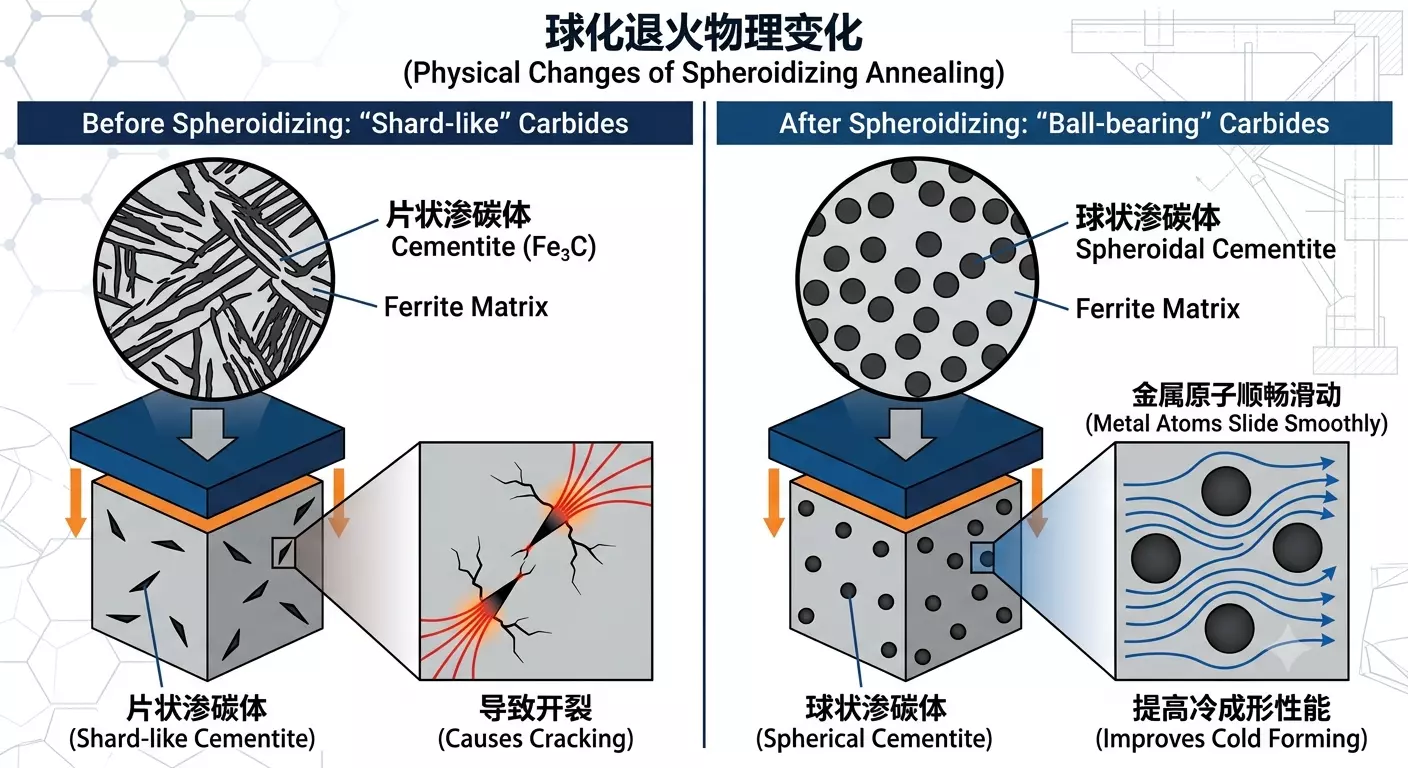
Spheroidizing annealing (Spheroidizing Annealing) is a heat treatment process, mainly used for medium carbon steel, high carbon steel, boron steel, alloy steel and some low carbon steel with high cold formability requirements. Its purpose is to the steel inside the original "lamellar" or "mesh" cementite (FeLPC), through a long period of heating and slow cooling, into a dispersion of spherical particles.
Physical changes: Imagine that flaky carburizing bodies are like broken glass, which easily pierce the metal matrix and cause cracking; while spherical carburizing bodies are like balls in bearings. When squeezed, metal atoms can slide smoothly around these "balls.
2. Why must cold heading use spheroized wire material?
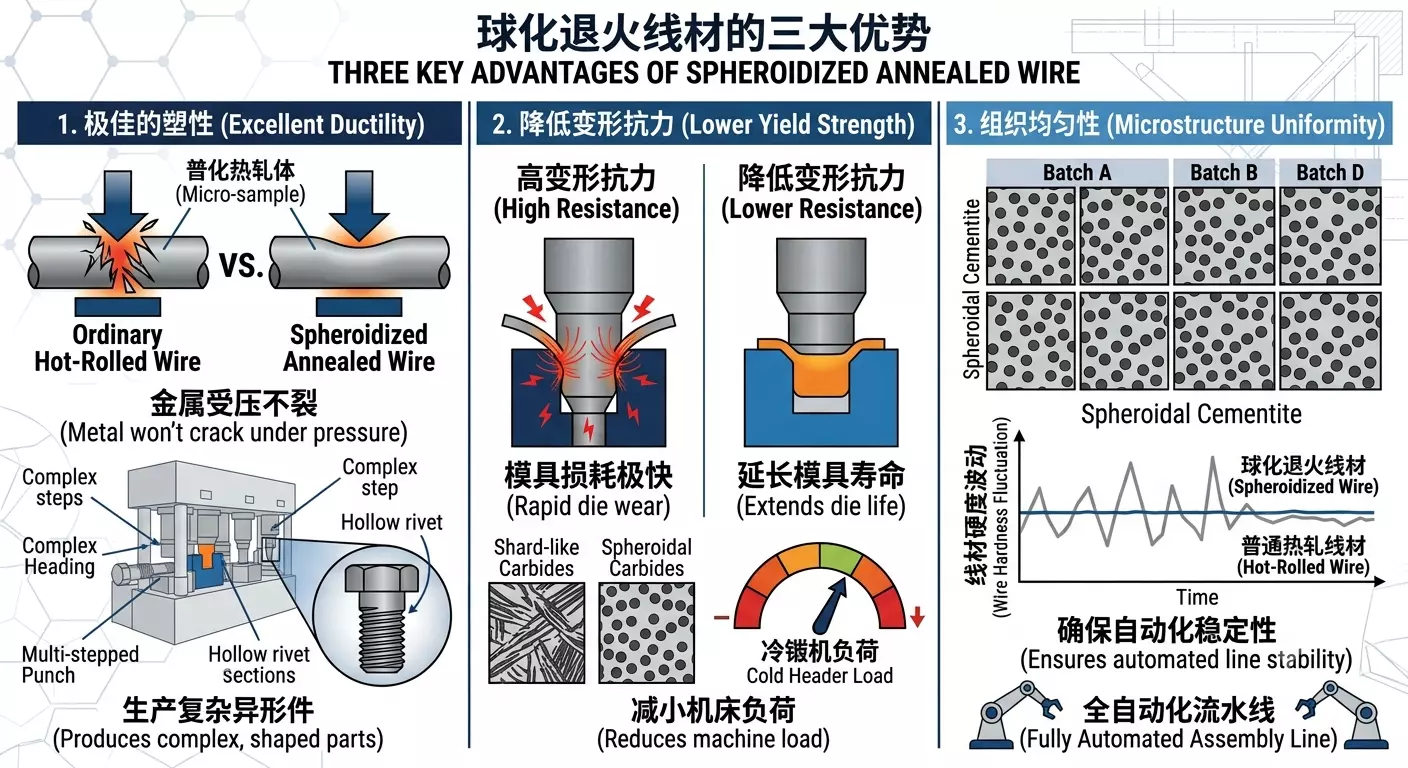
Ordinary plate element (hot-rolled state) has high hardness and brittleness. Direct cold heading will lead to extremely fast die loss and even direct bursting of parts. The spheroidized annealed wire has the following three advantages:
Excellent plasticity (Excellent Ductility): When the metal is under great pressure, it can produce severe deformation without microcracks. This is essential for the production of hollow rivets, step bolts and other complex shaped parts.
· Reduce deformation resistance (Lower Yield Strength): Reduce the load of cold heading machines and molds, significantly extending the life of expensive molds.
Organization uniformity (Microstructure Uniformity): to ensure that each batch of wire hardness fluctuation is very small, to ensure the stability of the fully automated production line.
3. Production process
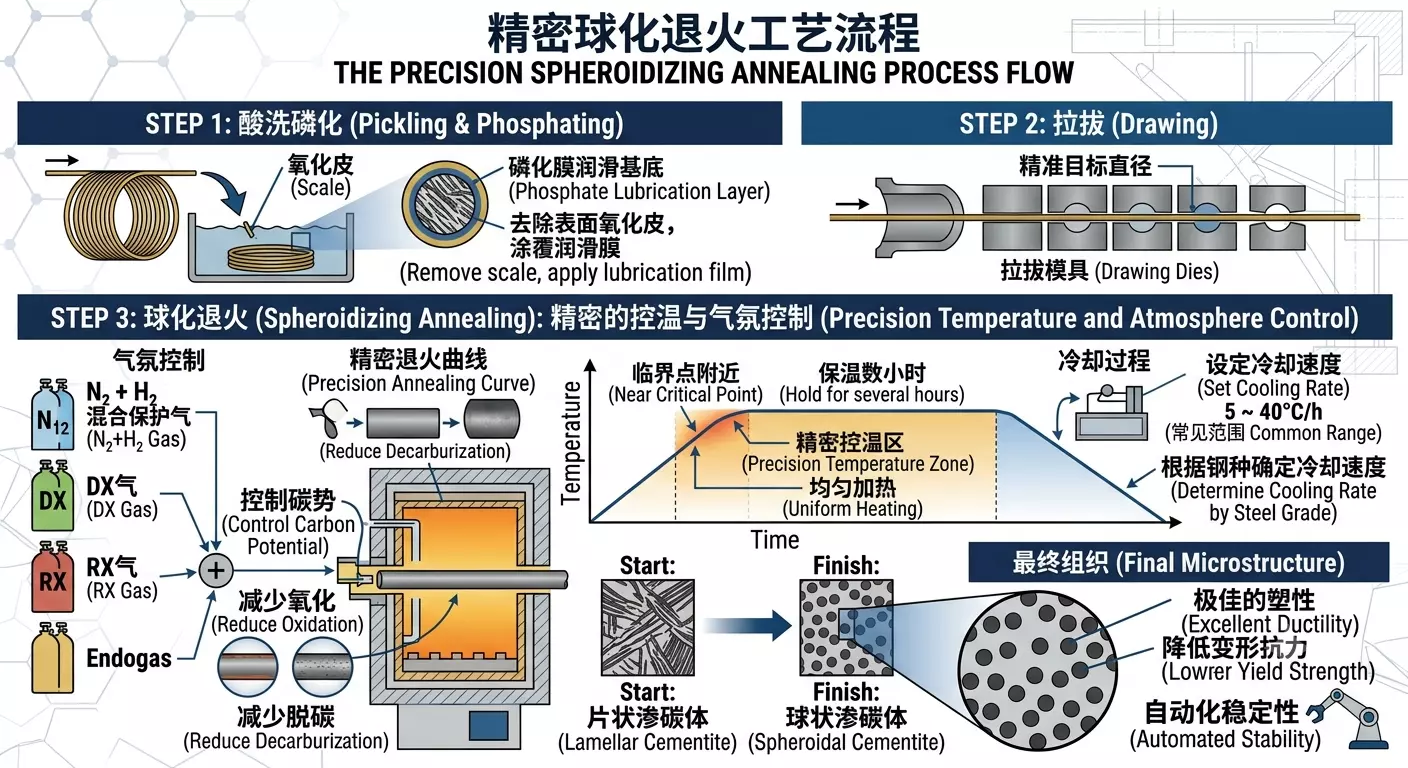
Sphroidizing annealing is not a simple "fire", it is an extremely precise temperature control process:
1. Pickling and phosphating (Pickling & Phosphating): remove the surface oxide skin and apply a layer of phosphating film as a lubricating base.
2. Drawing (Drawing): Pulling down the wire to the exact target diameter.
Surrounding annealing (Spheroidizing Annealing): In a protective atmosphere furnace (usually N₂ H₂ mixed protective gas, DX gas, RX gas or Endogas protective atmosphere is used to reduce oxidation and decarburization by controlling the carbon potential.) In the middle, heat to near the critical point, keep it for several hours, and then cool at a certain speed. The cooling rate should be determined according to the steel grade and target structure, and the common range is about 5~40 ℃/h.
The common process of cold heading wire rod should be determined according to the product grade and customer requirements.
RA:PC-RA
SA:PC-SA
RAIP:PC-RA-PC-D
(S)AIP:PC-SA-PC-D
SAF:PC-D-SA-PC
SAIP:PC-D-SA-PC-D
PASAF:PC-LA-PC-D-SA-PC
PASAIP:PC-LA-PC-D-SA-PC-D
PSASAIP:PC-SA-PC-D-SA-PC-D
Among them:
PC = pickling phosphating
LA = low temperature annealing
RA = ordinary annealing
SA = spheroidizing annealing
D = Pull
HD = Direct Draw
AIP = Process Anneal
4. Quality assessment criteria
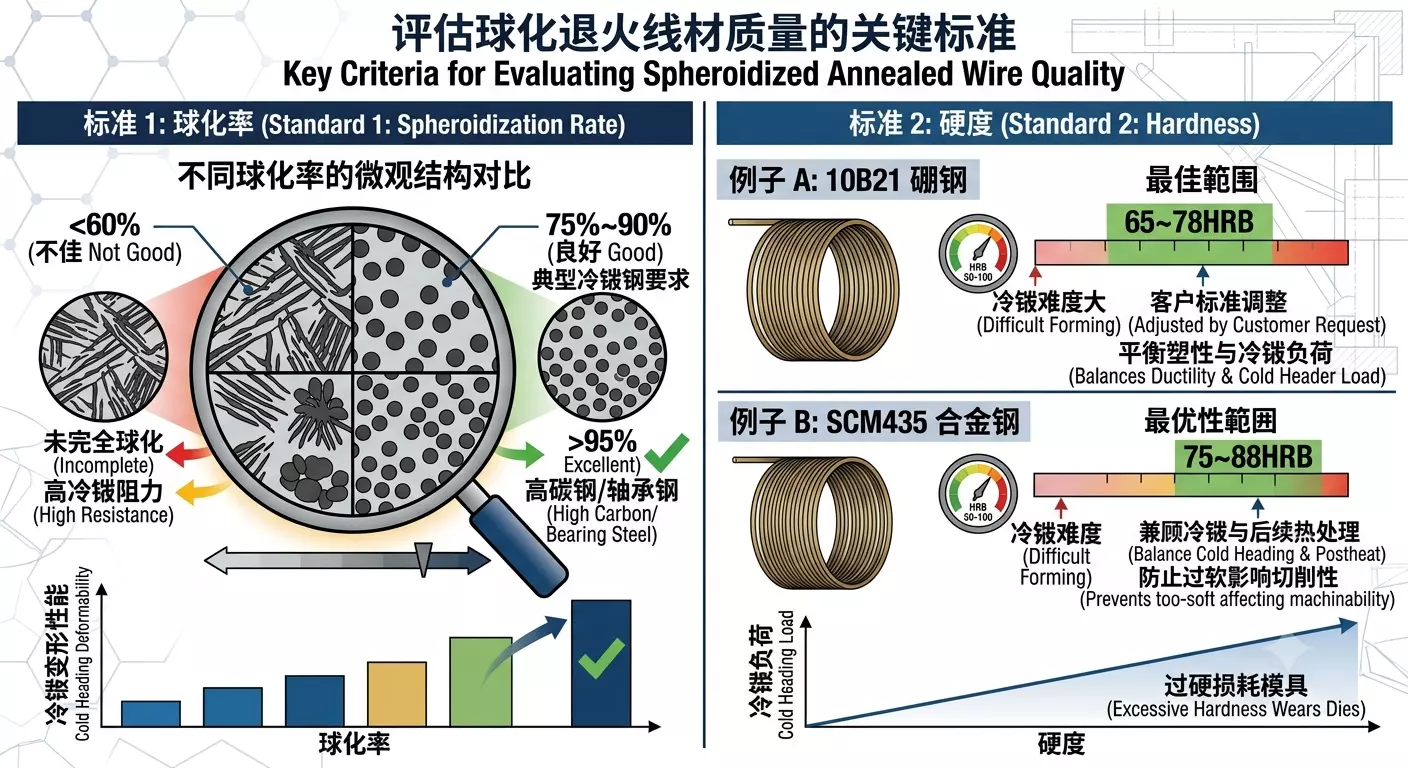
There are usually two criteria for judging whether a disc of spheroidized annealed wire is good or not:
Sballing rate (Spheroidization Rate): Sballing rate requirements should be determined according to the steel and end use. General cold heading steel requires about 60% to 90%, high carbon steel and bearing steel usually require a higher level of spheroidization.
Hardness (Hardness): For example, the hardness of 10B21 after spheroidization is usually controlled in the range of 65 ~ 78HRB, which is adjusted according to the difficulty of cold heading and customer requirements. The hardness of SCM435 after spheroidization is usually controlled in the range of 75 ~ 88HRB, in order to take into account the cold heading performance and subsequent heat treatment requirements.