CREATION GROUP · COLD FORMING SOLUTIONSEN

COLD FORMING MATERIALS

Why is there still a problem with cold heading when the materials are qualified?

MATERIALSENGINEERINGCREATION GROUP
CREATION GROUP / EN
In the cold industry, many companies have encountered similar situations:
Why is there still a problem with cold heading when the materials are qualified?
Latest news · fastener-wire.com ↗

In the cold industry, many companies have encountered similar situations:

In the cold industry, many companies have encountered similar situations:

For the same batch of materials, the chemical composition on the material certificate meets the standard, the mechanical properties meet the standard, the size also meets the requirements, and even the third-party test results are all qualified. However, after the material really enters the cold heading production, there may still be problems such as cracking, folding, insufficient R-angle filling, abnormal mold life, and product size consistency fluctuations.
In the cold industry, many companies have encountered similar situations:
At this time, many people's first reaction is often: Is there a material problem?

At this time, many people's first reaction is often: Is there a material problem?

At this time, many people's first reaction is often: Is there a material problem?
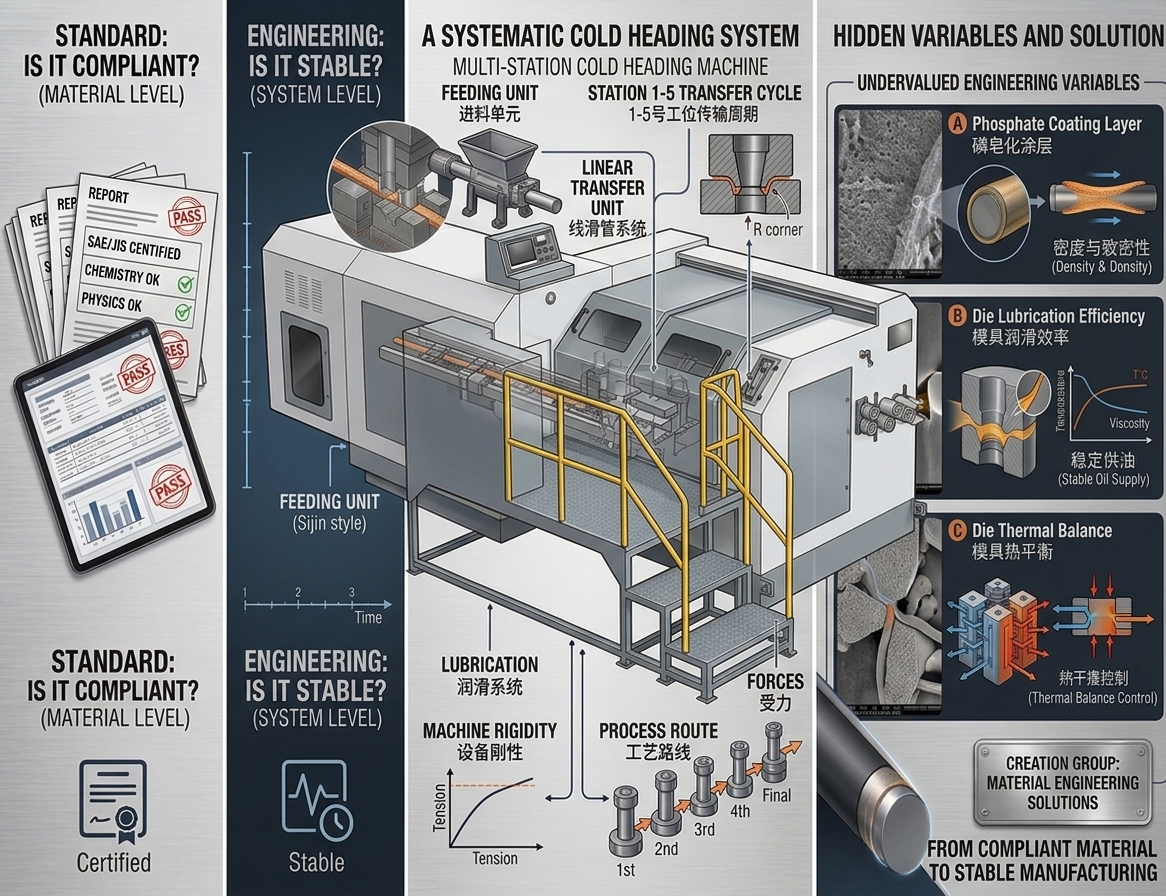
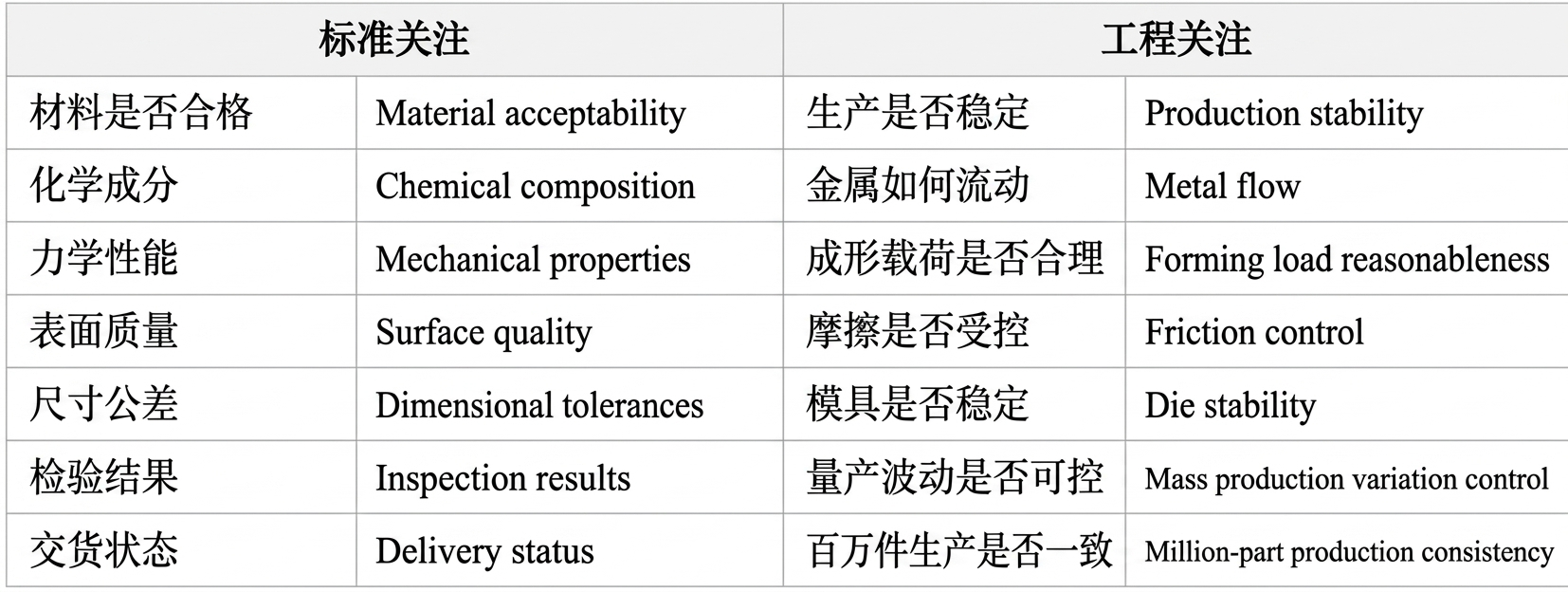
In fact, this problem cannot be simply attributed to material quality. More precisely, this is the difference between **product standards and engineering applications**. The standard main answer is: Is this material qualified? And cold heading engineering is really concerned about: Can this batch of materials be produced in a long-term, stable and low-fluctuation manner under my equipment, mold, lubrication conditions and forming process? These two questions are not the same thing.

What does the 1. material standard control?

What does the 1. material standard control?

1. What exactly do the material standards regulate? Whether it is SAE, JIS, EN, ASTM or ISO system, the core role of material standards is to specify the basic technical requirements that materials should meet. For cold heading and cold extrusion materials, the standard will usually cover the following: Chemical composition; Dimension and allowable deviation; Mechanical properties; Surface quality; Delivery status; Inspection method; Decarburization, inclusions, structures or other additional technical requirements in specific cases. For example, SAE J403 mainly specifies the chemical composition system of SAE carbon steel. JIS G 3507 is used for carbon steel wire and steel wire for cold heading. EN 10263 series is used for cold heading and cold extrusion steel. ISO 4967, ISO 3887, etc. are respectively used for the evaluation of non-metallic inclusions and decarburization depth. These standards are important because they establish a common language for material quality. But it must also be clear: The material product standard stipulates the technical conditions that the material should meet, and it is not a guarantee of "cold heading must be successful" under a specific part, a certain set of molds, and a certain equipment. Therefore, if the material meets the standard, it can only indicate that the material meets the requirements specified in the corresponding standard or technical agreement. It is not automatically equivalent: This set of materials must be suitable for all cold heading processes.
What does the 1. material standard control?
2. cold heading is a systematic project, not a separate material index.

2. cold heading is a systematic project, not a separate material index.

2. cold heading is a systematic project, not a separate material index.
Cold heading is essentially a bulk forming process in which metals undergo large plastic deformation at or near room temperature. The material in the mold will be subjected to compression, radial flow, local tension, shear and friction at the same time. The final stability of the forming depends not only on the material itself, but also on the entire manufacturing system. This system includes at least: Geometry of the product; Die design; Fillet of die; Forming step; Single channel deformation; Total deformation; Coaxiality of die; Rigidity of equipment; Forming speed; Temperature of mould; Lubrication state; Initial section of material; Delivery status before cold heading. Therefore, the same roll of material, in different enterprises, different equipment and even different molds, it is entirely possible to show different cold heading stability. This is also why the cold heading question cannot only ask one sentence: Does the material fit? Must also continue to ask: Is there a match between material, surface treatment, mold, equipment, lubrication and process?

3. the material factors that really affect the stability of cold heading are far more than the brand.


3. the material factors that really affect the stability of cold heading are far more than the brand.
Many procurement and engineering personnel are used to asking first: Is it SCM435? Is it SWRCH22A? Does the chemical composition exceed the standard? These questions are of course important, but the grade is only part of the identity of the material. There are several key factors that really determine the performance of cold heading. 1. Chemical composition stability and segregation The same grade allows the existence of a certain range of ingredients. Even if two batches of materials meet the standard, the actual location of C, Mn, Cr, Mo, B and other elements may be different, which may lead to different deformation resistance, spheroidization annealing response and subsequent heat treatment performance. For large size, high deformation or high strength fasteners, center segregation, banded structure and composition are of particular concern. Therefore, the real pursuit of cold heading materials is not only: Ingredients qualified. Rather: Ingredients are stable. 2. Steel purity and non-metallic inclusions Non-metallic inclusions are a component that cannot be completely avoided in the steel smelting process. For general-purpose materials, a certain level of inclusions may fully meet the standard; but for high deformation cold heading parts, automotive safety parts or fatigue-sensitive parts, local coarse, long or aggregate inclusions may become crack initiation sites. Therefore, the value of inclusion evaluation methods such as ISO 4967 and GB/T 10561 is not just to "make a rating report", but to help engineers judge: Whether there are defect sources inside the material that are detrimental to subsequent large plastic deformation. 3. Soccal tissue For medium carbon steel, alloy steel and bearing steel, the spheroidizing annealing state will directly affect the cold formability. The real concern in engineering is not just a simple "spheroidization rate" figure,: Whether carbide is fine and uniform; Whether coarse carbides exist; Whether obvious banded structure exists; Whether the ferrite matrix is uniform; Whether the center of the section is consistent with the surface structure. Insufficient spheroidization will increase the deformation resistance. Non-uniform spheroidization may cause differences in material flow at different locations. Therefore: The spheroidization rate is only one of the results, and the uniformity of the organization is the core that the cold heading project really needs to pay attention. 4. Surface quality and decarburization Cold heading materials are very sensitive to surface defects. Because in the process of cold heading, the surface material usually has a large plastic flow. If the raw material itself has cracks, folds, drawing scratches, indentations, excessive pickling or local decarburization, these defects may be further amplified in subsequent deformation. Especially surface cracks and folds, the danger lies in: They may not be obvious in the material detection stage, but they expand rapidly during large deformation. Therefore, for high-demand cold heading parts, only the tensile strength and hardness are not enough. 5. Drawing processing status The cold heading finishing line usually undergoes one or more times of drawing. Drawing not only changes the size, but also brings about work hardening, residual stress, surface and core hardness difference, tissue orientation and surface state changes. Therefore, even if the original wire rod is exactly the same, different surface reduction rates, different pass designs, different mold angles and different lubrication conditions may lead to differences in the cold heading performance of the final finished wire rod. This is also why: The actual performance of the same steel mill base material and the cold heading fine line produced by different restructuring plants may be completely different.
3. the material factors that really affect the stability of cold heading are far more than the brand.
4. two often underestimated engineering variables: phosphorus saponification film and equipment/mold capacity

4. two often underestimated engineering variables: phosphorus saponification film and equipment/mold capacity

4. two often underestimated engineering variables: phosphorus saponification film and equipment/mold capacity
If we only discuss the material organization, but not the lubrication and equipment, we still do not complete the cold heading problem. In the process of cold heading, the material and the die are in a state of high contact pressure, large plastic deformation and continuous friction. At this point, **surface lubrication system and equipment/mold running capacity**, will directly affect the material can flow smoothly. 1. Phosphorus saponification film: it is not as simple as "there is a layer of film on the surface" Steel cold heading wire usually adopts phosphating and saponification to form a composite lubrication system. In engineering, the truly excellent phosphorus saponification film should have lubricity, ductility, compactness, uniformity, binding force and oil storage/soap retention capacity at the same time. Lubricity The core function of lubricity is to reduce the friction and shear resistance between the material and the mold. When the lubrication ability is insufficient, the local friction will increase significantly, which will lead to the increase of cold heading load, the increase of surface temperature, the increase of mold wear, the obstruction of material flow, and even the risk of local strain, mold biting and cracking. Therefore, for high deformation cold heading parts, lubrication is not an auxiliary condition, but a part of the forming system. Ductility During the cold heading process, the surface area of the material will change significantly. If the film itself is too brittle, cracking, pulverization or large area shedding will occur as soon as the material enters the plastic deformation stage, and the subsequent process will easily turn into local dry friction. Therefore, a good phosphorus saponification system must not only "run", but also must be able to deform together with the matrix to a certain extent. In other words: A good film should not only be beautiful in a static state, but also be effective after deformation. Compactness and Uniformity If the phosphating film is locally too thin, too coarse, uneven crystallization or the existence of leakage plating area, it will cause uneven distribution of lubricant. The result is often not that the entire product fails at the same time,: Sudden rise in local friction. It is precisely this local instability that cold heading fears most. Therefore, the evaluation of the film should not only look at the average film weight, but also pay attention to whether the surface coverage is continuous, whether the crystal grains are uniform, whether there is local film shortage, whether the surface roughness is suitable for subsequent saponification, and whether the head, middle and tail of the same coil of wire are consistent. Binding force If the phosphating layer and saponification layer have insufficient bonding force with the substrate, they will fall off during the first forming, and the lubrication conditions of the subsequent stations will deteriorate rapidly. Insufficient binding force, usually manifested as pulverization, large film removal, powder accumulation in the mold, napping, biting the mold and abnormal wear of the mold. Therefore, the surface treatment of high-demand cold heading wire depends not only on whether there is a film, but also on: Whether the film can remain on the surface of the material under high contact pressure. Oil storage/soap retention capacity The value of the phosphating layer also lies in its ability to provide a certain bearing and storage space for the lubricating medium. The good phosphating structure can make the saponification layer play a more continuous role in the cold heading process, rather than being exhausted quickly after the first deformation. Therefore: Phosphating is not the final lubricant, but the basic carrier of the lubrication system. A truly effective friction control system is formed by the surface state of the matrix, the phosphating layer, the saponification layer and the mold lubrication. 2. Lubrication ability of equipment and mold Even if the surface of the material already has a good phosphorus saponification film, it cannot be considered that the lubrication problem has been completely solved. In the continuous high-speed cold heading process, the mold itself still needs to have a stable lubrication supply capacity. The project should focus on: Whether the lubricant can effectively reach the high deformation area; Whether the amount of lubrication is stable; Whether there is lubrication attenuation between multiple stations; Whether the lubricant has viscosity fluctuation due to temperature change; Whether there is a lubrication dead zone inside the die; Whether the lubricant can be replenished in high-speed production. For high-strength materials, large deformation parts and multi-station parts, the lack of lubrication is often manifested as abnormal forming load, product surface strain, mold temperature increase and rapid decline in mold life, and then may further develop into forming cracking. Therefore: To judge the stability of cold heading, one cannot only ask whether the material is saponified by phosphorus, but also whether the lubrication system of the whole equipment can continue to work. 3. Mold temperature control ability Cold heading is called "cold" heading, which does not mean that the mold is always kept at room temperature during continuous production. In actual high-speed production, a large amount of plastic deformation work and friction work will eventually be converted into heat. If the heat cannot be taken away in time, the local temperature of the mold will gradually increase. The temperature rise will further affect the lubricant viscosity, friction coefficient, mold size, mold material strength, mold life and product size consistency. Especially under the condition of high-speed continuous production, what really matters is not how much the mold temperature is at a certain moment,: Whether the mold can establish a stable thermal balance. If the mold temperature state is completely different between the 1000 parts before starting up and the continuous production of 100000 parts, the product state may drift even if the materials are exactly the same. Therefore, high-level cold heading equipment must not only "play fast", but also have stable lubrication ability, heat dissipation ability and heat balance control ability. 4. Mold structure, rigidity and coaxiality During cold heading, the material must flow in a highly controlled space. If the mold design is unreasonable, such as the fillet is too small, the local deformation is concentrated, the single-pass surface reduction rate is too high, or the material flow path is too long, it may cause the local strain to concentrate sharply. At the same time, if the equipment or mold system has insufficient accuracy of the slider, different axes of the mold, insufficient rigidity of the equipment or excessive guide gap, the material will be subjected to eccentric force. In this case, even if the material itself fully conforms to the standard, local stress concentration and abnormal cracking may occur. Therefore: It is not uncommon for the same batch of materials to be produced stably on one device and abnormal on another device. This does not necessarily mean who "has a problem", but that cold heading itself is a set of systems engineering.

5. why does the material meet the standard, it may still not meet a certain cold heading process?

5. why does the material meet the standard, it may still not meet a certain cold heading process?
The answer is actually very clear. Because the main definition of the material standard is: What requirements should the material itself meet. And the actual cold heading production is faced: Material Surface Treatment Lubrication Mold Equipment Temperature Process Route Product Structure Together constitute the manufacturing system. Therefore: Compliance with standards is one of the necessary conditions for entering cold heading production; but to achieve stable cold heading, the entire manufacturing system needs to be matched together. Both can be simply understood:
5. why does the material meet the standard, it may still not meet a certain cold heading process?
6. Creation Group's Understanding: Material Supply Cannot Stop at Material Proof

6. Creation Group's Understanding: Material Supply Cannot Stop at Material Proof

6. Creation Group's Understanding: Material Supply Cannot Stop at Material Proof
Many material suppliers are concerned about: Materials are not up to standard. For material suppliers who are truly facing high-demand cold heading customers, they must continue to take a step forward: How will this volume of material behave after entering the customer's mold? Therefore, in the process of cold heading material development and supply, Creation Group not only pays attention to chemical components such as C, Mn, Si, Cr and Mo, but also pays further attention to specific products and customer processes: spheroidized microstructure and its uniformity; Non-metallic inclusions; Decarburization and surface condition; The surface reduction rate of drawing and work hardening; Uniformity, compactness and adhesion of phosphating film; Lubricating effect of saponification and ductility of skin film; Customer cold heading deformation; Design of forming station; Die lubrication conditions; Equipment speed and mold thermal condition; Subsequent heat treatment requirements. Because for cold heading materials, what is really valuable is not: Report qualified. Rather: Customers can long-term stable production. Between these two sentences is the difference between material supply and material engineering.

Engineer's point of view: the standard determines whether the material is qualified, and the project determines whether the product is stable.


Engineer's point of view: the standard determines whether the material is qualified, and the project determines whether the product is stable.
For the cold heading industry, the material, phosphorus saponification film, lubrication, mold, equipment and forming process are not independent of each other, but a set of mutually coupled systems. The material meets the standard, only that it has the basic conditions to enter the manufacturing process. Truly excellent cold heading materials should exhibit stable, repeatable, low fluctuation forming ability under reasonable surface treatment, mold, lubrication and equipment conditions. Therefore: Conforming to the standard is the starting point of quality management; conforming to the process is the end of stable manufacturing.
Engineer's point of view: the standard determines whether the material is qualified, and the project determines whether the product is stable.
Standards and reference basis

Standards and reference basis

Standards and reference basis
The standard system involved in this paper includes: SAE J403:SAE carbon steel chemical composition system; ASTM A510/A510M: General requirements for wire and thick round steel wire; JIS G 3507: Carbon steel wire and steel wire for cold heading; EN 10263: Steels for cold heading and cold extrusion; ISO 4967: Microscopic evaluation of non-metallic inclusions in steel; ISO 3887: Determination of the depth of decarburization of steel; ASM Handbook, Volume 14A:Metalworking: Bulk Forming, cold heading, cold extrusion and volume forming related engineering reference. It should be noted that different inspection items and limits may be used for different materials, different products and different customer technical agreements. The specific supply and judgment shall be based on the specified standard of the order and the customer's technical requirements.

About Creation Group

About Creation Group
Creation Group focuses on cold heading wire, special-shaped wire and high-end cold forming material solutions. Our work is not only to the material production to "meet the standard", but also hope to help customers achieve more stable cold heading production through the collaborative control of material organization, surface treatment, dimensional accuracy, mechanical properties and the actual forming process of customers. A truly excellent material supplier should not only provide a roll of qualified steel wire, but also understand what will happen after the roll of steel wire enters the mold.
About Creation Group